



250KN Electro-Hydraulic Servo Fatigue Testing Machine
1. Overview:
The Electro-Hydraulic Servo Fatigue Testing Machine (hereinafter referred to as "the testing machine") is mainly used to test the dynamic characteristics of metals, non-metals, and composite materials at room temperature (or under high/low temperatures, corrosive environments). The testing machine can perform the following tests:
Tensile and compression tests
Crack propagation tests
It is composed of a closed-loop servo control system that includes an electrical controller, servo valve, load sensor, displacement sensor, extensometer, and computer, allowing for automatic and precise control of the testing process. It can automatically measure testing parameters such as test force, displacement, deformation, torque, and angle.
The testing machine is capable of generating sine waves, triangular waves, square waves, sawtooth waves, reverse sawtooth waves, pulse waves, and more, enabling it to conduct tensile, compression, bending, low-cycle, and high-cycle fatigue tests. It can also be equipped with environmental testing devices to perform simulation tests under various temperature conditions.
Operation of the testing machine is flexible and convenient, with the moving crossbeam's lifting, locking, and specimen clamping controlled by buttons. It adopts advanced hydraulic servo drive technology for loading, a high-precision dynamic load sensor, and a high-resolution magnetostrictive displacement sensor for measuring specimen force and displacement. The fully digital measurement and control system achieves PID control for force, deformation, and displacement, allowing smooth transitions between control modes. The testing software runs under the WINDOWS XP/Win7 Chinese environment, offering powerful data processing capabilities, automatic saving, display, and printing of testing conditions and results. The entire testing process is computer-controlled, making this machine an ideal high-cost-performance testing system for research institutes, metallurgy and construction, national defense and military industries, higher education institutions, machinery manufacturing, and transportation sectors.
2. Standards:
GB/T 2611-2007 General Technical Requirements for Testing Machines
GB/T 16825.1-2008 Verification of Static Uniaxial Testing Machines Part 1: Verification and Calibration of the Force Measuring System of Tensile or Compression Testing Machines
GB/T 16826-2008 Electro-Hydraulic Servo Universal Testing Machine
JB/T 8612-1997 Electro-Hydraulic Servo Universal Testing Machine
JB 9397-2002 Technical Conditions for Tension-Compression Fatigue Testing Machine
GB/T 3075-2008 Metallic Materials - Axial Fatigue Testing Method
GB/T 15248-2008 Metallic Materials - Axial Strain-Controlled Low-Cycle Fatigue Testing Method
GB/T 21143-2007 Metallic Materials - Unified Test Method for Determining Quasi-Static Fracture Toughness
HG/T 2067-1991 Rubber Fatigue Testing Machine - Technical Conditions
ASTM E399-09 Standard Test Method for Linear-Elastic Plane-Strain Fracture Toughness KIc of Metallic Materials
ASTM E1820-2001 Standard Test Method for Measurement of Fracture Toughness JIc
3. Main Components of the Testing Equipment:
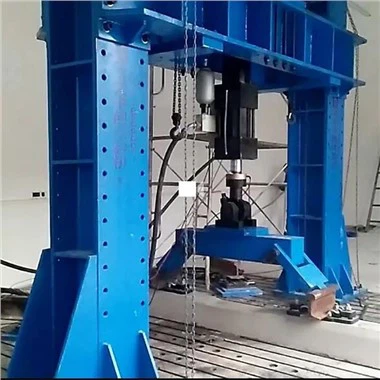
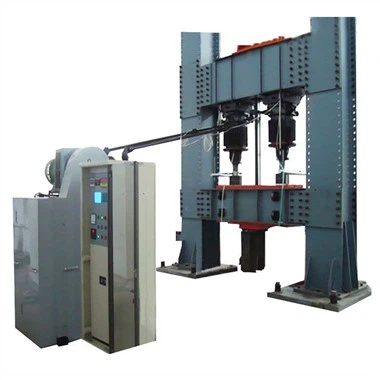
High-rigidity dual-column (or four-column) frame structure main loading frame.
Intelligent variable quiet oil source.
Fully digital dynamic and static control system.
Bilingual (Chinese/English) human-machine interface lower computer operating application software.
Advantech industrial computer and office printer.
Conventional testing accessories.
4. Main Technical Specifications:
|
Model PWS |
250H |
|
Maximum test force KN (dynamic and static) |
250KN |
|
Load frame |
Four columns |
|
Effective width of column mm |
650×500 |
|
Test space mm |
1000 |
|
Test force measurement range |
Dynamic 2%~100%FS |
|
Force accuracy and fluctuation |
Better than 1% of the indicated value; Amplitude fluctuation is not greater than ±1%F.S of each gear |
|
Test force resolution |
1/250000 code |
|
Test force indication accuracy |
Dynamic ±1%; Static 0.5% |
|
Displacement measurement range |
100mm(±50mm) |
|
Displacement measurement resolution |
0.001mmm |
|
Displacement indication accuracy |
Indication accuracy 1% and above within ±0.5%FS |
|
Deformation |
Indication accuracy 2% and above, within ±0.5% |
|
Frequency range |
Standard machine 0.01-20HZ (customizable up to 50Hz) Static pressure support 0.01-100HZ |
|
Main waveforms |
Sine wave, pulse wave, square wave, sawtooth wave, random wave (mainly supported by the controller) |
|
Auxiliary tools |
Forced flat push clamp, equipped with stretching rod and edge cutting jaws (optional) |
|
Compression aid (optional) |
IV. Main Unit Description:
Main Loading Frame: A two-column (or four-column) frame structure, with the servo actuator typically placed at the bottom for two-column models and at the top for four-column models.
Our standardized unit product.
Two-column (or four-column) main frame with hard chrome-plated, polished columns.
Upper crossbeam: Hydraulic lifting and locking. The maximum adjustable test clear space: ≥800mm.
Frame stiffness: 3 × 10^8 N/m.
Servo Actuator:
Maximum test force: Matched with model specifications.
Maximum stroke: ±100mm (total stroke 200mm).
A specialized dynamic servo actuator suitable for dynamic and static tests.
Double-rod design, with the piston rod surface treated with a special process for high smoothness, suitable for long-term dynamic testing.
High-speed sealing components (German Trelleborg servo Glyd ring and Stepseal) are used between the piston and cylinder body, and between the piston rod and the end cap. High-speed wear-resistant support rings (German Trelleborg) ensure high stiffness and strong lateral resistance.
Built-in displacement sensor, external electro-hydraulic servo valve, and load sensor, providing dual closed-loop control for force and displacement.
Load sensor is placed at the head of the piston rod with a pre-stress ring to ensure safe and reliable connection during dynamic testing.
Hydraulic buffer zones are designed at the extreme positions of the actuator's amplitude to prevent damage from uncontrolled operation.
Sensors:
Load Sensor: HBM or Interface (optional), suitable for bidirectional fatigue testing. Error margin: ±1%; calibrated before delivery.
Displacement Sensor: Products from Nanjing AMT or MTS USA, non-contact magnetostrictive displacement sensors. Effective range (maximum displacement): ±100mm. Paired with the control system, with an error margin of ±0.5%FS; calibrated before delivery.
Servo Valve: MOOG servo valve, 21Mpa pressure, directly integrated with the actuator through a servo valve mounting base.
Intelligent Variable Servo Power Source: The intelligent variable servo pump station is a standardized, modular design that can theoretically be cascaded into a large-scale pump station with any flow rate, offering excellent scalability and flexibility.
Total flow rate: 0000L/min, pressure: 21Mpa (adjustable based on test requirements).
Total power: 0000kW, 380V, three-phase, 50Hz, AC.
The pump station is designed and manufactured based on standard modular units, ensuring mature technology and stable performance, with an intermediate pressure stabilizing module connected to the actuator.
The pump station consists of an oil pump, motor, high/low-pressure switching valve group, accumulator, oil filter, oil tank, piping system, and more.
The filtration system uses three levels of filtration: oil pump inlet (100μ), oil source outlet (3μ), and the intermediate pressure stabilizing module (3μ).
The oil pump is a variable pump from Germany's Rexroth, which intelligently adjusts flow rates, minimizes overflow, generates low heat, operates quietly, and offers excellent durability and a long lifespan.
A high/low-pressure switching valve group is used for starting and stopping the hydraulic system.
The fully enclosed standard servo oil tank has a capacity of no less than 260L and features temperature measurement, air filtration, and oil level display functions.
Forced Clamping Unit: 4.1 Hydraulic Forced Clamping Head: One set.
Hydraulic forced clamping, with a working pressure of 21Mpa, suitable for high-low-frequency fatigue tests involving tensile and compressive zero-crossing.
Adjustable working pressure range: 1Mpa-21Mpa.
Open structure for easy jaw replacement.
Self-locking nut connects to the load sensor at the upper part of the main unit and to the actuator piston at the lower part.
Round specimen clamping jaws: 2 pairs; Flat specimen clamping jaws: 2 pairs (expandable). 4.2 Compression Test Fixture: One set.
Compression plate diameter: φ100mm.
Piping System:
All hydraulic hoses use products from Parker, USA.
The piping length between the main unit and the pump station: 3-6m (determined based on lab layout).
Other hoses include the hydraulic clamp hose, lifting cylinder hose, etc., all imported from the USA.
Electrical Control System:
Cabinet structure, placed near the pump station with Siemens PLC for intelligent remote control.
Design meets national standards for strong electrical systems.
Automatically switches between high and low pressure, with low-pressure startup and high-pressure operation.
Total power: 000kW, AC, 380V, three-phase, five-wire system.
The cabinet includes voltage and current meters and buttons for controlling the start and stop of two sets of motors.
Equipped with various protection and alarm functions such as low oil level, temperature over-limit, oil filter clogging, and motor overload.
Wires and cables are arranged reasonably for easy maintenance and an aesthetically pleasing appearance.
The client is responsible for power supply.
Remote Control Cabinet:
Placed in the control room, PLC controls the start and stop of three motors.
Clear and reliable alarm and operation indicator lights.
Remote electronic pressure gauge for monitoring pump station pressure, with various alarm indicators for oil filter clogging, temperature over-limit, etc.
Operates safely at 24V working voltage, providing a safe, aesthetically pleasing, and user-friendly interface.
Cooling System: The equipment includes a built-in cooling system, which is generally sufficient for low-frequency tests without requiring an additional cooling system. Recommendations for additional cooling devices will be made based on user-provided parameters.
Control System and Computer Software System: 8.1 Main Controller Configuration:
Test force signal conditioning unit, 1 set.
Displacement signal conditioning unit, 1 set.
Servo valve drive unit, 1 set.
Signal generator unit, 1 set.
Hydraulic control unit (pump station on/off, high/low-pressure switching, etc.), 1 set.
Fully digital closed-loop control, capable of digital PID control for any signal acquisition. Closed-loop control frequency up to 5kHz.
Directly integrates the servo valve drive unit (servo valve drive available).
Built-in signal generator frequency range: 0.001-1000Hz, with frequency resolution of 0.001Hz.
Control waveforms: Sine wave, triangle wave, square wave, ramp wave, sawtooth wave, random wave, and custom waveforms with combined output capability.
Control modes: Force, displacement, deformation PID closed-loop control, enabling smooth, disturbance-free switching between modes.
The system has functions such as sensor calibration and zeroing.
Achieves high-speed data communication with the computer through an Ethernet card.
Offers complete hydraulic control functions, such as controlling pump station on/off and high/low-pressure switching.
Provides various interface boards compatible with different sensors and drive units.
8.2 Software System: The software system is a mainstream multi-channel dynamic testing system, widely applicable to various testing standards with flexible operation and convenient data import/export, making it especially suitable for research institutions. Main features include:
Developed based on the Win7/10 platform.
Integrates various dynamic test functions.
For dynamic tests, allows the definition of arbitrary waveform combinations to create test spectra and processes, enabling the testing machine to perform complex dynamic fatigue tests.
For static tests, integrates software modules for major international standards and domestic GB standards in the field of material testing, making it powerful and suitable for both research and routine process studies.
Allows programming of functions such as data acquisition, test steps, data storage, and test protection in event form, assisting users in performing various complex test operations.
8.3 Computer and Printer:
Advantech brand industrial computer from Taiwan.
24" LCED display.
Win7 operating system.
HP A4 laser printer.
Testing Accessories:
Tensile test accessories (optional).
Compression test accessories (optional).
Provides test accessory drawings (optional).
Spare Parts and Tools:
Spare filter element (filter accuracy 3µ): 1 piece, for replacing the filter element when the oil filter is blocked.
Flushing module solenoid valve: 1 piece.
Specialized tools for the equipment: 1 set.
V. Unresolved Issues: Any unresolved matters will be settled through negotiation between both parties.
Hot Tags: 250kn electro-hydraulic servo fatigue testing machine, China 250kn electro-hydraulic servo fatigue testing machine manufacturers, suppliers, Servo Hydraulic Fatigue and Fracture Testing Machine, High Frequency Fatigue Testing Machine, Torsional Fatigue Testing Machine, Dynamic Fatigue Tester, Horizontal Tensile Fatigue Testing Machine
Previous
No InformationYou Might Also Like




Send Inquiry