

Tensile Testing Machine
The Best Tensile Testing Machine Manufacturer!
Jinan Nake Test Equipment Co., Ltd. is a high-tech entity enterprise integrating R&D, production and sales established in July 2009.
Why Choose Us
Experienced
As a specialized testing equipment manufacturer with over 20 years of industry experience, our company is backed by a team of more than 20 R&D experts, over 50 skilled production personnel, and a professional after-sales service team of 10+ members.
Our Certification
Our ISO 9001:2015-certified management system ensures consistent product quality.
OEM Customization
We provide OEM manufacturing services for 20+ Chinese exporters, producing around 2000 units of mechanical testing equipment annually, further solidifying our industry leadership.


What is Tensile Testing Machine
A tensile tester or tensile testing machine is used to determine the strength and deformation behavior of a material up to the point of fracture. Choosing the right tensile testing machine depends on the material to be tested and the standard(s) that must be followed.
Benefits of Tensile Testing Machine
Quality Assurance
Helps in maintaining high quality standards by verifying the mechanical properties of materials.
Product Development
Provides critical data for designing and developing new products with enhanced performance characteristics.
Cost Efficiency
Reduces material waste and production costs by ensuring that materials meet specified standards.
Regulatory Compliance
Assists manufacturers in complying with industry standards and regulations for material strength and safety.
Enhanced Reputation
Demonstrates a commitment to quality, enhancing the brand's reputation and consumer confidence.
Aerospace and Aviation Industry
Choosing lightweight materials that can help reduce fuel consumption but still satisfy the specific application’s strength requirements
Verification of the functionality of composite materials – Combination of different materials that have superior specific strength compared to a single material
To test for tensile strength of adhesive bonds, carpets, cables, gaskets, hoses, seat belts, wiring looms, and harnesses
Automotive Industry
Determination of the breaking strength of a seat belt, which is crucial for automotive safety, as well as the car seat’s foam rubber
Assessing the quality of exterior fittings, such as door and window seals, mirrors, mud flaps, and bumper moldings and trims
Assessing the quality of interior fittings, such as airbags, dashboards, handles, mirrors, and handbrake levers
Using tensile test to develop and perform quality control on lightweight and high-strength materials, which are essential in safety and fuel economy
Metals and Construction Industry
The most popular method of testing metals – By metal fabricators to assess the tensile strength of steel preparation, produce materials with the right ductility and strength, and pass the compliance standards to ensure high-quality and safe materials
To test tensile strength of safety support nettings, timbers, and geotextiles
Testing bond strength of adhesives, sealants, mastics, and between layers of brick and foam
Electrical and Electronics Industry
Tensile straining of conductive film and substrate used in flexible electronics to determine their mechanical and electrical behavior
Characterizing pull-off properties of crimped, soldered, or welded electrical contacts and components
Measuring tensile strength of printed circuit board (PCB) materials
Testing for tensile strength of electrical wires to meet specific requirements
Measuring withdrawal force of connectors
Medical Equipment and Materials Industry
Assessing the compression and tensile strength of lenses to guarantee it can withstand everyday use
Tensile strength testing surgical tubes to identify its mechanical properties and possible material and junction defects that could harm the patient
Testing catheters to assess intra-tubular flexion and accurate transmission of torsion necessary to change direction through guide wires
Determine whether bandages, dressings, and textile materials are elastic enough
Identifying the elongation of surgical gloves, silicone rubbers, and other soft stretchable medical materials
Testing the strength of needles and injectors
Testing the joint strength of respiratory masks and IV connector fittings
Packaging and Paper Industry
Measuring the elongation and strength of plastics, board, or paper
Measuring the maximum load that a material can withstand before it tears or ruptures
Assessing how easy or difficult it is to open a packaging
Measuring the force required to tear a seal, adhesive bond, or label and open snap-caps and pop-caps
Characterizing the folding properties of cartons and boxes
Knowing the tensile properties of paper that has to be fed to automated machines, and run through huge rolls over long distances at high speeds to print different paper products
Plastics and Rubber Industry
Testing the strength and rigidity of carbon fiber reinforced plastics or CFRP
Assessing whether rigid and flexible plastic and rubber products have enough strength to withstand external physical stress
Identification of the elongation and necking or yield strength of plastic and rubber products
Evaluation of the strength of interlocking rubber or plastic components
Testing the adhesion of plastic or rubber labels
Measuring the quality of products made from plastic or rubber
Sport and Fitness Industry
Tensile testing not only during production of strings but also checking the tensile strength, knot strength, elongation of strings at certain loads to ensure quality of tennis, squash, and badminton rackets
Testing tensile strength of thermoplastic elastomers and vulcanized rubbers used in soles of athletic footwear and sports equipment
Testing tear and tensile strength of leather and fabrics used in performance footwear, apparel, and equipment to guarantee that failures are minimized
Textiles Industry
Assessing whether a fabric is strong enough to be wearable and resist damage from regular use
Testing the breakage strength, tear resistance, and elongation of natural and synthetic fabrics, thread, yarns, cords, and ropes
Testing the strength of vulnerable seams
Characterizing pull-off properties of buttons, zip fasteners, stitched decorations, poppers, hook-and-loop fasteners, and press studs
Load Frame
The load frame is the main structure of the tensile testing machine and houses all the essential components. It is designed to withstand the forces applied during the tensile strength test process.
Crosshead
The crosshead is a movable component that holds the grips or fixtures used to secure the material being tested. It applies the force to the specimen in a controlled and uniform manner.
Grips/Fixtures
These are attachments that firmly hold the ends of the test specimen during the test. The selection of grips depends on the type of material being tested .
Load Cell/Load Sensor
The load cell is a transducer that measures the force applied to the specimen. It converts the applied force into an electrical signal that is recorded by the testing machine’s data acquisition system.
Extensometer
An extensometer is an optional accessory that measures the elongation or strain of the specimen during the test. It provides valuable data to construct stress-strain curves.

Types of Materials That Can Be Tested with a Tensile Testing Machine

Metals such as steel, aluminum, and copper are commonly tested using a tensile testing machine. This allows manufacturers to ensure that these materials meet the required quality standards for their intended applications. By subjecting the metal samples to tension until they break, engineers can analyze factors like yield strength, ultimate tensile strength, and elongation.
Plastics are another category of materials that can be effectively tested using a tensile testing machine. Different types of plastics have varying properties such as flexibility, hardness, and impact resistance. By conducting tests on plastic samples under controlled conditions, manufacturers can determine if their products meet international quality standards.
Textiles also undergo rigorous testing using a tensile testing machine. Fabrics need to withstand pulling forces without tearing or breaking during everyday use. The ability of fabrics to stretch without losing shape or durability is an important factor in determining their suitability for specific applications.
Composites made from combining two or more different materials also benefit from being tested using a tensile testing machine. Whether it's carbon fiber reinforced polymers (CFRP) or fiberglass composites, these advanced materials must demonstrate high strength and stiffness while maintaining optimal weight ratios.
What Are The Main Components Of A Universal Tensile Testing Machine
Load Frame: The load frame is the main structure of the testing machine and provides the framework for the entire system. It is typically made of sturdy materials such as steel to withstand the applied loads. The load frame houses other components and ensures the stability and rigidity of the machine during testing.
Crosshead: The crosshead is the movable part of the testing machine that applies the load to the specimen. It is connected to the load frame through a drive system and can move vertically or horizontally. The crosshead is responsible for the controlled displacement and speed during the test.
Grips or Jaws: Grips, also known as jaws, hold the specimen securely in place during testing. They are typically designed to grip the specimen without damaging it and provide a uniform distribution of the applied load. Grips can be mechanical, hydraulic, or pneumatic, depending on the testing requirements and the type of specimen being tested.
Load Cell: The load cell is a transducer that converts the applied force or load into an electrical signal. It measures the force exerted on the specimen during the test. Load cells are typically calibrated and have a specified load range to ensure accurate and reliable force measurements.
Displacement Measurement System: The displacement measurement system measures the movement or deformation of the specimen during the test. It can include various types of position sensors, such as linear variable differential transformers (LVDTs), extensometers, or optical encoders. These sensors provide precise measurements of the specimen's elongation or displacement.
Control System: The control system is responsible for operating and controlling the testing machine. It includes various components, such as motors, drives, and controllers, to control the movement of the crosshead, load application, and displacement rate. The control system allows for the precise control of testing parameters, such as load rate and strain rate.
Data Acquisition System: The data acquisition system collects, records, and processes the data generated during the test. It typically includes data acquisition devices, software, and a computer interface. The system captures load and displacement data from the load cell and displacement sensors, allowing for real-time data analysis and plotting of load-displacement curves.
Safety Features: Tensile testing machines are equipped with safety features to protect the operator and ensure safe testing procedures. These may include emergency stop buttons, overload protection mechanisms, and safety interlocks to prevent accidents or damage to the machine.
Accessories and Fixtures: Tensile testing machines may have various accessories and fixtures to accommodate different types of specimens and testing requirements. These can include different types of grips, extensometers, temperature chambers, or special fixtures for specific tests, such as compression or flexural tests.
Control Panel: The control panel is the user interface of the testing machine. It allows the operator to set and control various testing parameters, such as load rate, displacement rate, and testing modes. The control panel also displays test data, provides status indicators, and allows for the adjustment of machine settings.
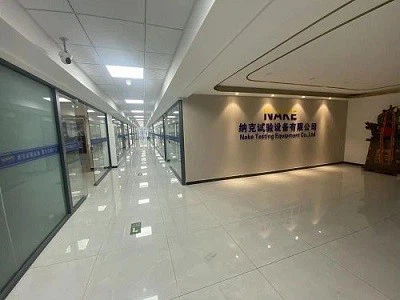
Our Factory
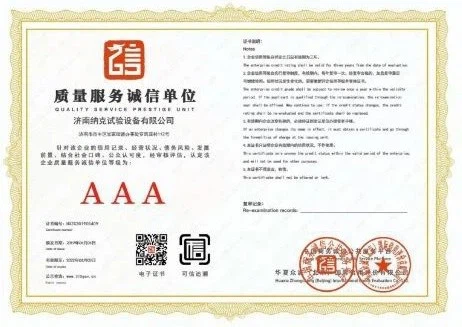
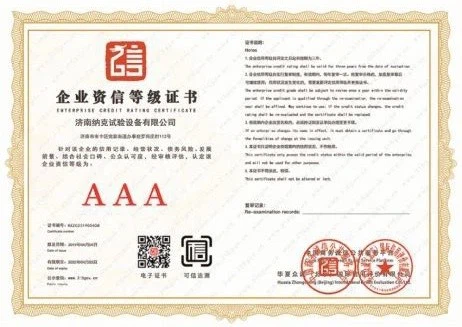
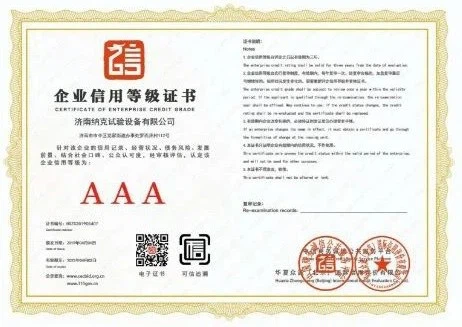
In 2018, the company was rated as an AAA credit rating enterprise; in 2019, it passed the ISO9001:2015 international quality management system certification. On August 17, 2020, it was rated as a national high-paying technology enterprise. In April 2022, it was rated as a specialized and special new technology enterprise in Jinan.


Certifications